
In education, success should not mean that a student always needs a teacher standing beside them.
A truly successful learning experience should gradually help students develop the confidence and skills to understand concepts, identify their weaknesses, solve problems, plan their studies, and seek help when they genuinely need it.
This is the idea behind independent learning.
At Igniters Online, the online wing of Igniters for Tomorrow, we believe the role of a teacher is not simply to provide answers. A good teacher should eventually help students learn how to find, understand, evaluate, and apply knowledge independently.
Research on learning autonomy similarly emphasizes students’ ability to plan, monitor, and evaluate their own learning rather than remaining passive recipients of information.
What Is an Independent Learner?
An independent learner is not a student who never asks for help.
In fact, knowing when and how to ask for help is an important part of independent learning.
An independent learner gradually develops the ability to:
- Set realistic learning goals.
- Organize study time.
- Identify strengths and weaknesses.
- Attempt problems independently.
- Learn from mistakes.
- Monitor progress.
- Ask meaningful questions.
- Choose appropriate learning strategies.
- Take responsibility for improvement.
The goal is to move students from:
“Teacher, tell me the answer.”
to:
“I tried this approach, but I am stuck here. Can you help me understand where I went wrong?”
That is a significant change in the way a student thinks.
1. We Encourage Students to Think Before Giving Them Answers
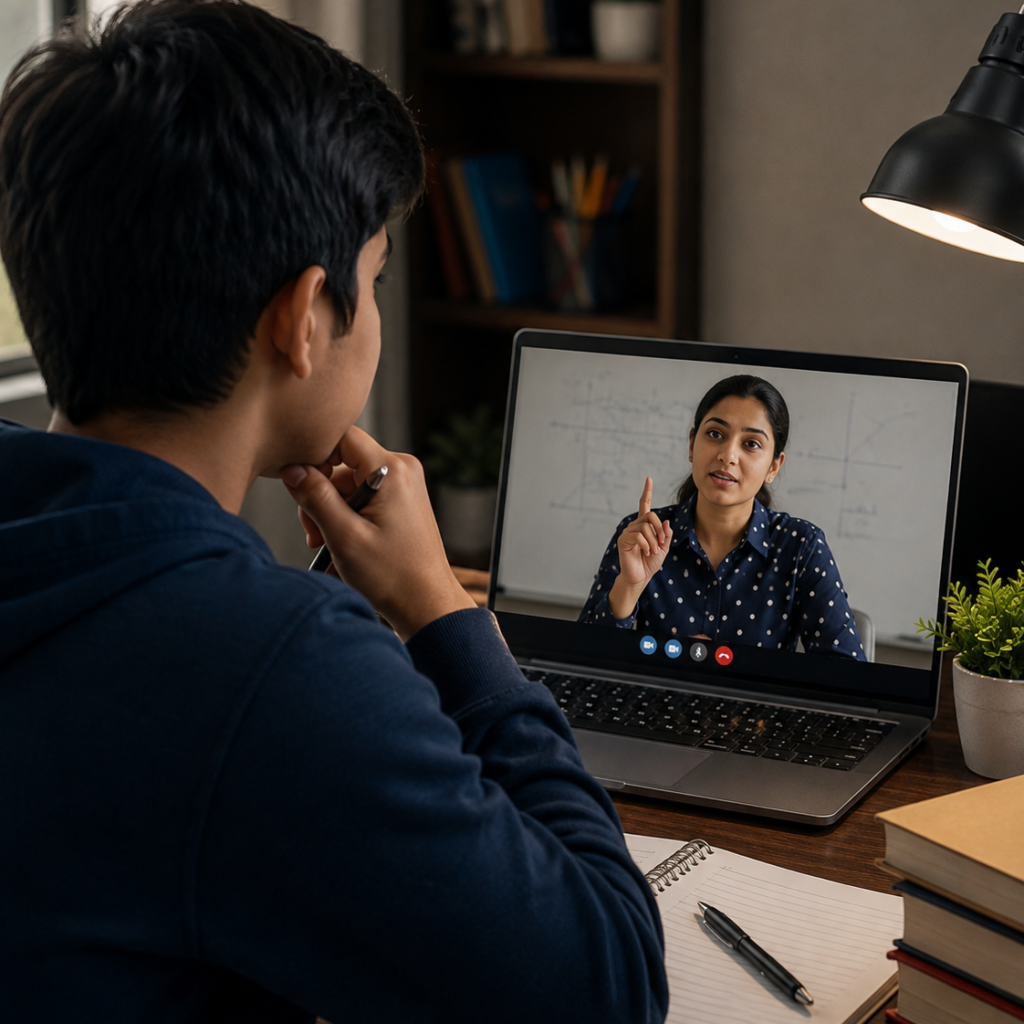
One of the easiest ways to make students dependent is to immediately provide solutions whenever they face difficulty.
At Igniters Online, we believe students should first get an opportunity to think, attempt, and make mistakes.
For example, when a student encounters a difficult Physics numerical, the teacher can guide the student with questions such as:
- What information is given?
- What are you trying to find?
- Which concept might apply?
- Can you draw a diagram?
- What have you tried so far?
This approach provides support without taking away the student’s opportunity to think.
Over time, students become more comfortable approaching unfamiliar problems independently.
2. We Focus on Concepts Rather Than Solution Memorization
Independent learning becomes difficult when students depend on memorized procedures.
If a student memorizes one method for one type of question, they may struggle when the question changes.
Conceptual understanding gives students something more valuable: the ability to adapt.
At Igniters Online, we encourage students to understand:
Why does this work?
rather than simply:
Which formula should I use?
Once students understand the underlying concept, they can apply it to different situations.
This is particularly important in Science and Mathematics, where higher-level questions often require students to connect multiple ideas.
3. We Teach Students How to Learn, Not Just What to Learn
Knowing what to study is only one part of academic success.
Students also need to know how to study effectively.
We encourage learning practices such as:
- Active recall
- Regular revision
- Problem-solving
- Error analysis
- Self-testing
- Goal setting
- Progress monitoring
These habits gradually give students greater control over their own learning.
Independent learning is a skill that develops over time through structure, practice, reflection, and gradually increasing responsibility.
4. Mistakes Become Learning Opportunities
Many students become dependent on teachers because they are afraid of making mistakes.
They may avoid attempting a difficult problem because they don’t want to get it wrong.
At Igniters Online, we want students to understand that an incorrect answer can be useful if you learn why it was incorrect.
Students can analyze:
- Was the concept misunderstood?
- Was the question interpreted incorrectly?
- Was there a calculation error?
- Was the wrong formula selected?
- Was the solution approach incomplete?
This process develops self-awareness.
Instead of simply seeing a wrong answer as failure, students learn to use it as feedback.
5. We Encourage Students to Ask Better Questions
Independent learners are not students who stop asking questions.
They ask better questions.
There is a difference between:
“I don’t understand this.”
and:
“I understand Newton’s Second Law, but I’m confused about why the acceleration changes in this particular situation.”
The second question demonstrates that the student has already thought about the problem.
Our goal is to create an environment where students feel comfortable asking questions and gradually become better at identifying exactly what they don’t understand.
6. Personalized Guidance Helps Students Understand Their Own Learning

Every student has different strengths and weaknesses.
One student may need more practice with numerical problems. Another may understand concepts but struggle with time management. Someone else may need to improve revision habits.
Personalized learning can help students become more aware of these differences.
At Igniters Online, academic guidance can focus on questions such as:
- What are you good at?
- Where are you struggling?
- What type of mistakes are you making?
- Which topics need more practice?
- What study strategy works best for you?
This kind of reflection is important because students eventually need to be able to answer these questions themselves.
7. We Gradually Transfer Responsibility to the Student
Independent learning doesn’t happen overnight.
A student cannot suddenly be told:
“From today, manage everything yourself.”
Effective independence develops gradually.
Initially, the teacher may provide considerable structure:
Teacher explains → Student practices → Teacher gives feedback
As the student becomes more confident, the process can evolve:
Teacher guides → Student attempts → Student evaluates → Student improves
Eventually, the student becomes increasingly capable of deciding:
- What needs revision?
- Which questions require more practice?
- When should help be requested?
- Which strategy should be used?
Educational approaches that promote self-directed learning commonly use scaffolding, feedback, personalization, responsibility, and self-assessment to gradually build student autonomy.
8. Online Learning Can Support Independence—If Used Correctly
Online education provides students with flexibility, but flexibility alone doesn’t guarantee independent learning.
A student can spend hours watching videos without actually learning.
That’s why online learning should combine:
Teaching + Interaction + Practice + Feedback + Reflection
At Igniters Online, our aim is to use the flexibility of online education while maintaining the human connection and mentorship students need.
The objective is not to make students dependent on an online platform.
It is to help them eventually become confident learners who can learn effectively even when a teacher is not immediately available.
9. We Help Students Become Problem Solvers
Science and Mathematics provide an excellent environment for developing independence.
Instead of giving students a fixed procedure for every question, we encourage them to explore:
- What information do I have?
- What do I need?
- Which concepts might connect?
- Can I approach the problem differently?
- Does my answer make sense?
These habits extend beyond examinations.
A student who learns how to approach an unfamiliar Physics problem is also developing a general problem-solving mindset.
10. In education, success should not mean that a student always needs a teacher standing beside them.

This may sound surprising, but we believe it is one of the most important responsibilities of a good teacher.
The objective isn’t to make students permanently dependent on their teacher.
It is to gradually make them capable of learning without constant supervision.
The teacher begins as an instructor, becomes a guide, and eventually becomes a mentor whom the student knows they can approach when genuinely needed.
This is not about removing teachers from education.
It is about making students more capable because of their teachers.
What an Independent Igniters Student Should Eventually Be Able to Do
Our long-term goal is to help students develop the ability to:
Understand → Attempt → Analyze → Correct → Improve → Repeat
Instead of:
Listen → Copy → Memorize → Forget
The first cycle develops ownership of learning.
The second can create dependence on instruction.
Why Independent Learning Matters Beyond Exams
Board Exams, IIT-JEE, NEET, Olympiads, IAT, and other examinations are important milestones.
But students will eventually move beyond school and competitive examinations.
At university and in professional life, nobody will provide a complete timetable for every day. New problems will not always come with solved examples. Students will need to learn unfamiliar topics and adapt to new situations.
The ability to learn independently therefore becomes a lifelong skill.
The OECD similarly identifies the capacity to direct and regulate one’s own learning as an important foundation for lifelong learning.
How Igniters Online Fits Into This Journey
At Igniters Online, we see ourselves not simply as a source of lectures or study material, but as a partner in a student’s learning journey.
Our approach combines:
- Concept-based teaching
- Interactive online classes
- Personalized academic guidance
- Problem-solving
- Regular practice
- Feedback
- Mentorship
- Reflection and improvement
The aim is simple:
Support students today so that they can become more capable learners tomorrow.
Final Thoughts
The ultimate measure of education is not how dependent a student becomes on a teacher.
It is how confidently the student can eventually think, learn, question, and solve problems independently.
At Igniters Online, we want students to leave every learning experience with more than another completed chapter. We want them to develop the confidence to approach the next chapter themselves.
Because the purpose of a great teacher is not to provide every answer.
It is to teach students how to find better answers themselves.
Leave a Reply