
Online education has changed the way students learn. Today, a student can access thousands of lectures, notes, question banks, mock tests, educational videos, and digital resources from almost anywhere.
At first glance, this seems like everything a student needs to succeed.
But there is an important question:
Does having access to more study material automatically lead to better learning?
Not necessarily.
A student may have access to excellent resources and still struggle with questions such as:
- What should I study first?
- Which topics are actually important?
- Why am I repeatedly making the same mistakes?
- How should I balance school and competitive exam preparation?
- Which study strategy is right for me?
- When should I revise?
- Why am I studying for hours but not improving?
This is where mentorship becomes important.
At Igniters Online, the online wing of Igniters for Tomorrow, we believe that effective online education should combine high-quality teaching and resources with personalized academic guidance and mentorship.
Study Material Gives Information. Mentorship Gives Direction.

A mentor can help you understand: what to learn, why to learn it, how to learn it, and what to do when you struggle. Study material can tell you what to learn.
Imagine two students preparing for the same examination. Both receive the same textbook, lectures, practice sheets, and mock tests. One student performs consistently well. The other keeps struggling despite putting in considerable effort. The difference may not be the quality of the study material. The second student may simply need help identifying the problem. Perhaps the student has weak fundamentals. Perhaps they are spending too much time watching lectures and not enough time solving problems. Perhaps they are revising inefficiently. Perhaps they understand concepts but struggle to apply them.
Study material alone cannot always identify these issues. A mentor can.
1. Online Learning Requires Direction
One of the biggest advantages of online education is flexibility.
But flexibility can also become a challenge.
Without proper guidance, students may:
- Jump between multiple resources.
- Keep collecting study material.
- Watch lectures without practicing.
- Spend too much time on low-priority topics.
- Keep postponing revision.
- Follow someone else’s timetable without considering their own needs.
A mentor can help convert unlimited resources into a clear learning path.
Instead of asking:
“What should I study today?”
students gradually learn to ask:
“What is my current goal, what is my priority, and what should I do next?”
That is a major step toward becoming an independent learner.
2. Every Student Has Different Learning Needs
A standard course assumes that students can follow the same sequence and pace.
Real students are different.
One student might be excellent at Mathematics but struggle with Physics. Another may understand Physics concepts quickly but need additional practice with numerical problems. A third student may have strong knowledge but poor exam time management. Giving all three students exactly the same resources may not solve their individual problems. Mentorship allows learning to become more personalized.
At Igniters Online, we believe academic guidance should consider a student’s:
- Current understanding
- Strengths
- Weaknesses
- Learning pace
- Practice patterns
- Test performance
- Academic goals
The goal is not to make every student learn in exactly the same way.
It is to help every student move forward from their own starting point.
3. Mentors Help Students Understand Their Mistakes
A test score tells you what happened. It doesn’t always tell you why it happened.
Suppose a student scores 55% in a Physics test. The score alone doesn’t reveal the underlying problem.
Were the mistakes caused by:
- Weak concepts?
- Incorrect formula selection?
- Calculation errors?
- Misreading questions?
- Lack of practice?
- Poor time management?
- Exam pressure?
A mentor can help students analyze these patterns.
Instead of simply saying:
“You need to study harder.”
the better question is:
“What exactly is preventing you from improving?”
That shift can make preparation much more effective.
4. Mentorship Prevents Resource Overload
The internet has created an unusual problem in education:
There is too much information.
A student preparing for JEE or NEET can find hundreds of videos explaining the same chapter. They can download multiple books, PDFs, question banks, short notes, revision videos, and test series.
More resources do not necessarily mean more learning. In fact, constantly switching resources can create confusion and reduce consistency.
A mentor can help students decide:
- Which resources to prioritize.
- Which material is sufficient.
- When additional practice is necessary.
- When to stop collecting resources and start solving questions.
Sometimes the best academic advice is simply:
“You already have enough resources. Now use them properly.”
5. Mentors Provide Accountability
Online learning requires self-discipline. There is no physical classroom reminding students every few minutes to stay focused.
A mentor can provide a structure of accountability through:
- Study goals
- Regular assessments
- Progress reviews
- Feedback
- Revision plans
- Academic discussions
Accountability does not mean constantly pressuring students.
It means helping them remain consistent with the goals they have chosen.
6. Mentorship Is Especially Important for Board + JEE/NEET Preparation

Students preparing for Board Exams and competitive examinations face a unique challenge.
They need to manage:
- School classes
- Homework
- Practical work
- Board preparation
- Competitive exam practice
- Revision
- Mock tests
Without proper planning, students can easily feel overwhelmed.
A mentor can help integrate these priorities instead of treating them as completely separate tasks.
For example, a strong conceptual lesson can be followed by:
NCERT learning → Board-style questions → JEE/NEET questions → Revision → Test
This allows students to build one strong conceptual foundation that supports multiple examinations.
7. A Mentor Can Help Students Become Independent Learners
Mentorship is not about telling students what to do forever. In fact, the ultimate goal should be the opposite.
A good mentor gradually helps students develop the ability to:
- Plan their own studies.
- Identify weak areas.
- Choose appropriate strategies.
- Analyze mistakes.
- Set realistic goals.
- Monitor their own progress.
The student gradually moves from:
“Tell me what to study.”
to:
“Here is my plan. Can you help me improve it?”
That is the development of academic independence.
8. Mentorship Provides Human Connection
Technology can provide information instantly. But students are not machines.
They can experience:
- Frustration
- Self-doubt
- Lack of motivation
- Confusion
- Fear of failure
- Difficulty maintaining consistency
A mentor provides a human perspective during these situations.
Sometimes a student doesn’t need another lecture.
They need someone to help them understand what went wrong and what to do next.
This human element is particularly important in online education.
9. Igniters Online: Learning Beyond Study Material
We believe that educational resources are important—but they are only one part of effective learning.
Our approach combines:
Conceptual Teaching
Students focus on understanding ideas rather than simply memorizing information.
Interactive Learning
Students participate, ask questions, and solve problems.
Personalized Guidance
Academic support is adapted to individual learning needs.
Regular Assessment
Tests and practice help identify areas requiring improvement.
Mentorship
Students receive guidance on planning, preparation, and progress.
Independent Learning
The ultimate goal is to help students gradually take ownership of their education.
This approach is particularly relevant for students in Classes 8–12 preparing for Board Exams, IIT-JEE, NEET, Olympiads, IAT, NDA, and other academic goals.
What Should You Look for in an Online Mentor?
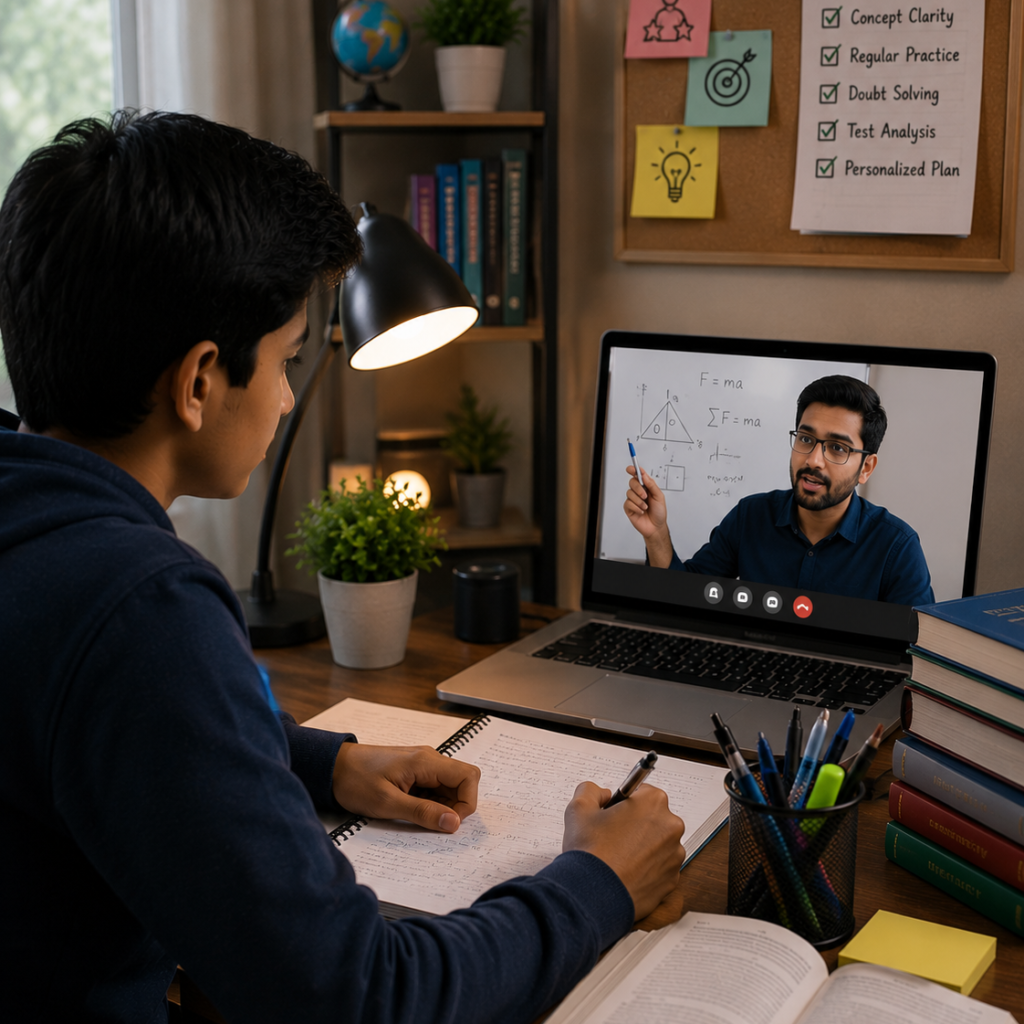
If you are a student or parent evaluating an online coaching platform, don’t look only at the number of lectures or PDFs available.
Ask:
Can students interact directly with teachers?
Is there a system for doubt-solving?
Does someone monitor academic progress?
Are students given individual feedback?
Does the platform help students create realistic study plans?
Are mistakes analyzed rather than simply scored?
Does the teaching approach encourage independent thinking?
These questions can reveal much more about the quality of an online learning experience than the size of its content library.
Study Material + Teaching + Mentorship = Complete Learning
Teachers are essential. Study material is valuable. Technology is powerful.
But when these elements work together with personalized mentorship, online education can become significantly more meaningful.
Think of it this way:
Study Material = Resources
Teacher = Knowledge and Explanation
Practice = Skill Development
Assessment = Feedback
Mentorship = Direction
All five contribute to a student’s learning journey.
Final Thoughts
The biggest advantage of online education is not the amount of content a student can access.
It is the ability to create a flexible and personalized learning experience.
But personalization requires more than algorithms, videos, and PDFs.
It requires people who understand students.
At Igniters Online, we believe that students don’t need an endless supply of study material. They need the right concepts, the right practice, the right feedback, and the right guidance at the right time.
Because education is not simply about giving students more information.
It is about helping them know what to do with it.
Leave a Reply