
Education in India is undergoing a remarkable transformation. Over the last few years, online learning has moved from being an alternative to traditional education to becoming an important part of the modern education ecosystem.
Students can now attend live classes from home, access high-quality learning resources, interact with teachers digitally, take online assessments, and receive academic guidance without being limited by geographical location.
But the future of online education in India is not simply about replacing classrooms with laptops and smartphones. The real transformation will be about making education more personalized, interactive, accessible, and effective.
For students studying Science and Mathematics, particularly those preparing for Board Exams, IIT-JEE, NEET, Olympiads, IAT, and other competitive examinations, this transformation could create opportunities that were difficult to imagine a generation ago.
How Online Education Has Changed Learning in India
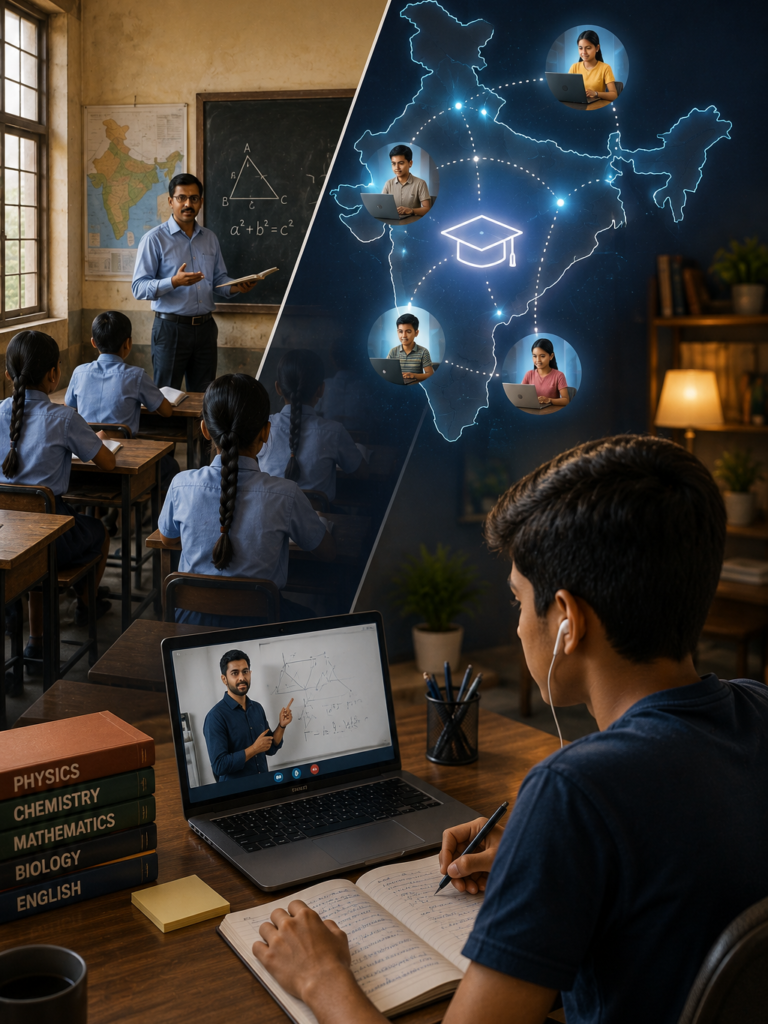
Traditional education has historically been dependent on location. A student’s access to a particular teacher or institution often depended on where they lived.
Online education has changed this equation.
A student in a small town can potentially learn from an experienced teacher located hundreds of kilometres away. Students can attend live classes, revisit difficult concepts, access digital resources, and communicate with teachers without travelling to a coaching centre.
This has made quality education more accessible to a much larger population.
However, accessibility is only the beginning. The next phase of online education must focus on quality and personalization.
The Future Will Be About Personalized Learning
One of the biggest weaknesses of traditional mass education is that every student is often expected to learn at approximately the same pace.
But students are different.
One student may understand Physics quickly but struggle with Mathematics. Another may need additional time to understand fundamental concepts but eventually become excellent at problem-solving.
Technology can help education adapt to these differences.
Future learning platforms are likely to increasingly use student performance data to identify:
- Strong and weak concepts
- Learning gaps
- Revision requirements
- Question difficulty levels
- Individual learning patterns
- Areas requiring additional practice
This can help teachers provide more targeted academic support.
The future of online education therefore isn’t simply “more videos.”
It is more personalized learning.
Artificial Intelligence Will Transform Education
Artificial Intelligence is likely to become one of the most influential technologies in education.
AI can assist students with:
- Personalized practice questions
- Instant feedback
- Adaptive learning
- Revision recommendations
- Doubt clarification
- Performance analysis
- Study planning
However, AI should not replace teachers.
Education involves much more than answering questions. Teachers provide mentorship, encouragement, context, motivation, and human understanding.
The most effective future model is likely to be human teachers supported by intelligent technology.
Online Learning Will Become More Interactive
The early generation of online education was heavily dependent on recorded lectures.
Students watched videos, downloaded notes, and completed assignments.
The future is likely to be much more interactive.
Students may increasingly participate in:
- Live problem-solving sessions
- Virtual laboratories
- Simulations
- Interactive quizzes
- Collaborative projects
- Digital whiteboards
- Real-time assessments
This is particularly important for Science education.
Imagine learning Physics not only through a lecture but also through an interactive simulation where you can change variables and immediately observe what happens.
That kind of experience can turn abstract concepts into something students can explore.
Online + Offline Will Become More Powerful
The future of education is unlikely to be completely online or completely offline.
Instead, hybrid learning may become increasingly important.
Online platforms provide:
- Flexibility
- Accessibility
- Digital resources
- Personalized practice
- Remote mentorship
Physical classrooms provide:
- Social interaction
- Laboratory experiences
- Peer learning
- Direct teacher interaction
Combining the strengths of both models can create a more complete educational experience.
The Teacher Will Become a Mentor
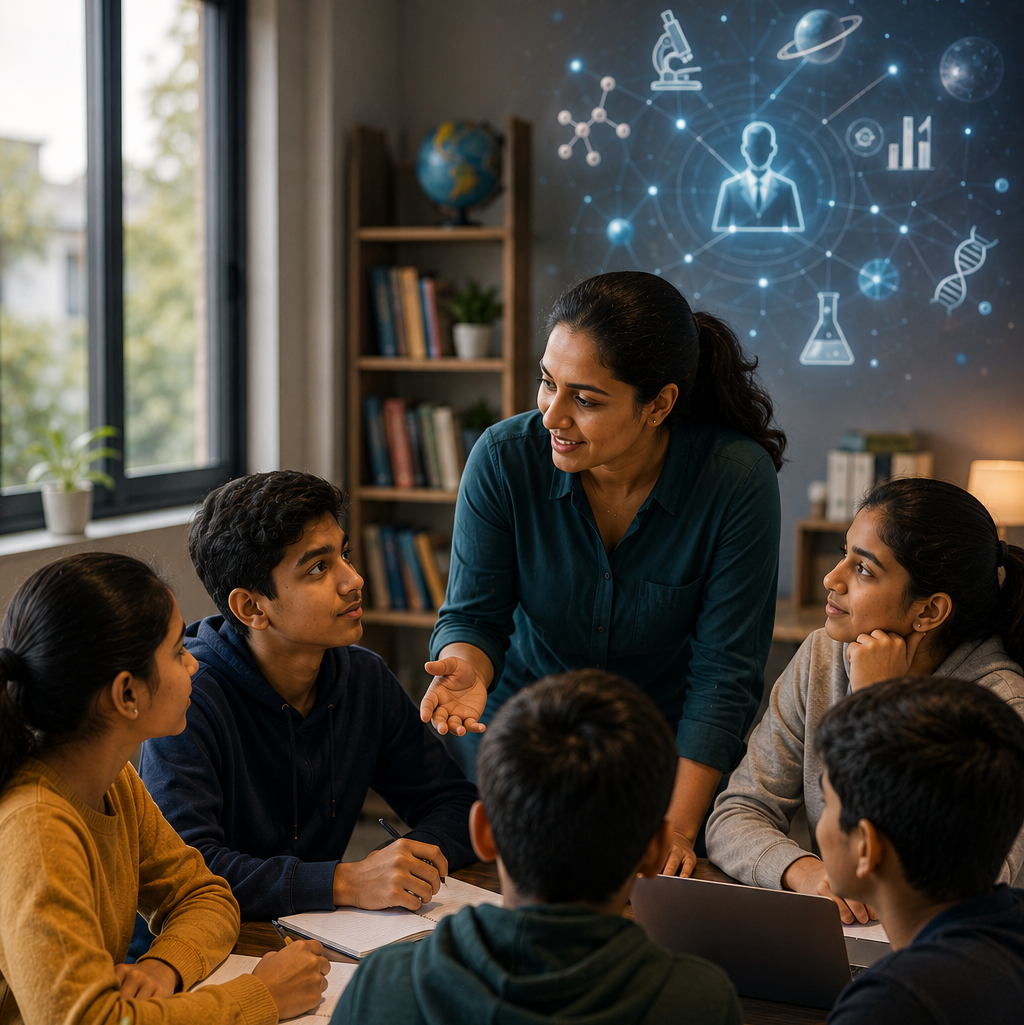
Technology can provide information.
But information is not the same as education.
Students still need someone who can help them understand:
- What they should study
- What they should ignore
- Where they are making mistakes
- How they should improve
- How they should manage their time
- How they can stay consistent
This is why mentorship will become increasingly important.
The successful education platforms of the future will not simply sell lectures. They will build long-term learning relationships between students and educators.
Online Education Can Reduce Geographical Inequality
India has students from thousands of cities, towns, and villages.
Access to experienced teachers and specialized coaching can vary significantly depending on location.
Online education can help reduce this geographical gap.
A student does not necessarily have to move to a major educational hub to access specialized instruction.
This is particularly valuable for students interested in areas such as:
- Olympiad preparation
- Advanced Mathematics
- Physics
- Research-oriented science
- IIT-JEE
- NEET
- IAT
- NDA
Technology can bring specialized learning opportunities closer to students.
But Online Education Has Challenges
The future of online education is promising, but it also has significant challenges.
Screen Fatigue
Students spending excessive time in front of screens may experience reduced concentration and fatigue.
Distractions
A device used for studying can also provide access to games, social media, and entertainment.
Lack of Discipline
Online learning requires students to develop self-discipline and time-management skills.
Quality Variation
Not every online course provides the same quality of teaching, mentorship, or academic support.
Passive Learning
Watching hours of lectures without solving problems or interacting with teachers can create the illusion of learning without genuine understanding.
These challenges demonstrate why simply putting education online is not enough.
The quality of the learning experience matters more than the technology itself.
What Will Make Online Education Successful?
The strongest online education models are likely to combine five elements:
1. Excellent Teachers
Technology cannot compensate for poor teaching.
2. Personalization
Students should receive guidance according to their individual needs.
3. Interaction
Learning should involve questions, discussions, problem-solving, and feedback.
4. Mentorship
Students need academic direction and accountability.
5. Technology
AI, analytics, simulations, and digital tools should support teachers and students rather than replace meaningful human interaction.
The Future of Science Education
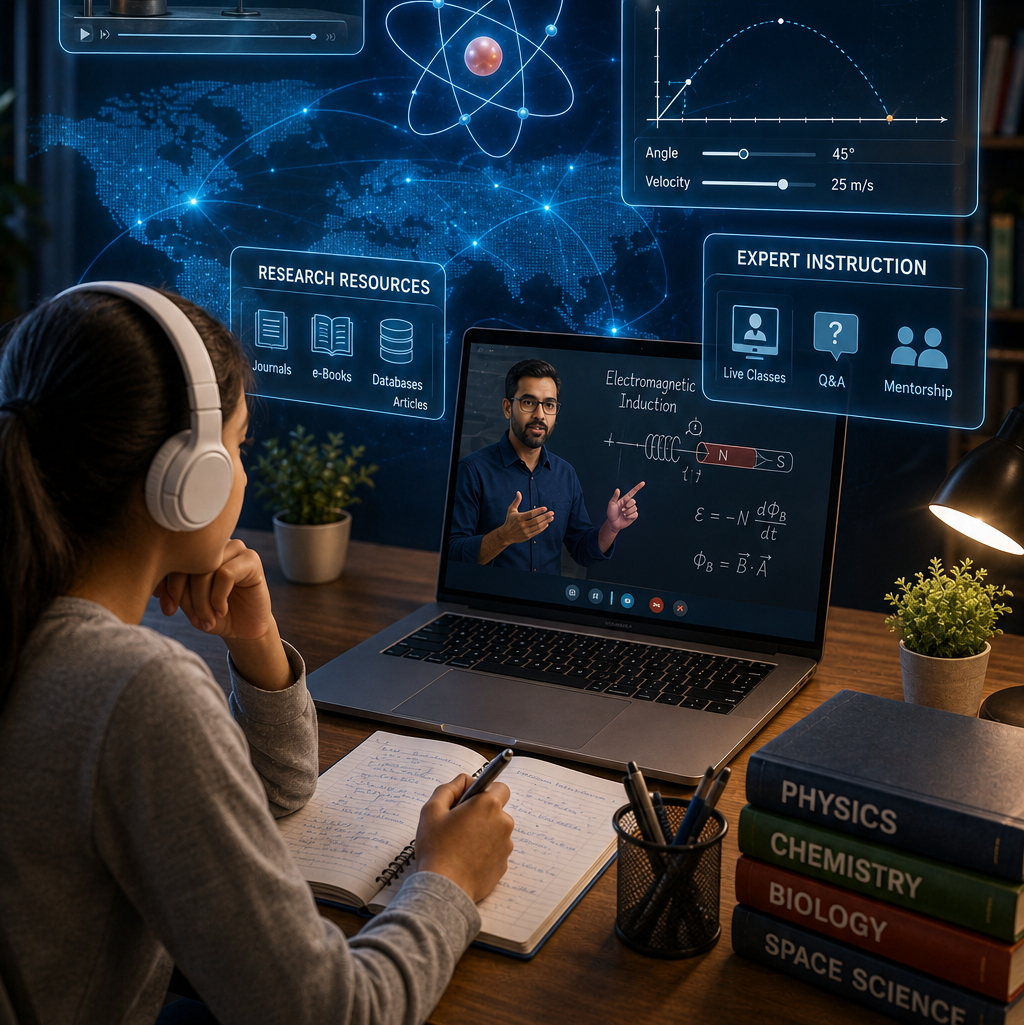
Science education has enormous potential in the online environment.
Students can access simulations, virtual experiments, interactive visualizations, research resources, and expert instruction from anywhere.
But the ultimate goal should not be producing students who can memorize more information.
India needs students who can:
- Ask meaningful questions.
- Think critically.
- Solve unfamiliar problems.
- Conduct experiments.
- Analyse evidence.
- Build new ideas.
- Apply scientific knowledge to real-world problems.
The future of Science education therefore lies in moving from memorization to exploration.
How Igniters Online Sees the Future
At Igniters Online, the online wing of Igniters for Tomorrow, we believe the future of education lies at the intersection of technology, personalized mentorship, and conceptual learning.
Our approach is designed around the idea that students should not simply consume educational content. They should actively participate in the learning process.
We aim to support students from Classes 8–12 in Science and Mathematics while helping them prepare for Board Exams, IIT-JEE, NEET, Olympiads, IAT, and NDA.
Our focus is on building strong foundations, encouraging curiosity, providing personalized academic guidance, and helping students develop the problem-solving abilities required for the future.
Technology is the medium.
The student remains at the centre of education.
Conclusion
The future of online education in India is not about choosing between technology and teachers.
It is about bringing the strengths of both together.
Technology can make education more accessible, personalized, and flexible. Teachers can provide the human guidance, mentorship, curiosity, and inspiration that technology alone cannot provide.
For India’s students, this transformation represents a tremendous opportunity.
The education system of tomorrow should not simply produce students who know more facts. It should develop better thinkers, problem-solvers, innovators, researchers, and lifelong learners.
That is the future we should be building—and at Igniters Online, we believe every student’s curiosity can be the beginning of that journey.
Leave a Reply