
Online education has made quality teaching accessible to students regardless of where they live. But there is a major difference between attending an online class and actually learning through one.
A student can watch a two-hour recorded lecture, download hundreds of pages of study material, and still struggle to understand a concept.
At Igniters Online, the online wing of Igniters for Tomorrow, we believe that effective online education should be interactive, concept-based, personalized, and mentorship-driven.
Our objective is not simply to complete a syllabus. It is to make sure students understand what they are learning, know how to apply it, and gradually become independent learners.
So, what does a typical class at Igniters Online actually look like?
Let’s take a look.
1. Every Class Begins With a Learning Objective

A good class needs a clear purpose.
Before beginning a topic, the teacher establishes what students are expected to understand by the end of the session.
For example, instead of simply announcing:
“Today we will study Newton’s Laws.”
the class may begin with questions such as:
- Why does a passenger move forward when a moving bus suddenly stops?
- Why is it easier to push an empty trolley than a loaded one?
- What exactly does force do to an object?
These questions create curiosity before the formal concept is introduced.
Students don’t simply receive information—they begin thinking about the problem first.
2. Concepts Come Before Formulas
Science and Mathematics are not collections of formulas to memorize.
At Igniters Online, we emphasize understanding the reasoning behind a concept.
Suppose students are learning a Physics formula.
Instead of immediately asking them to memorize it, the teacher may explore:
- Where does the relationship come from?
- What does each quantity represent?
- What happens if one variable changes?
- Where can the concept be applied?
- What are its limitations?
This approach helps students develop conceptual understanding that remains useful beyond a single examination.
3. Students Are Encouraged to Ask Questions
One of the biggest problems with passive online learning is that students can become silent viewers.
At Igniters Online, questions are an important part of the learning process.
Students are encouraged to ask when:
- A concept is unclear.
- A step in a solution is confusing.
- Two concepts appear contradictory.
- They want to understand a different approach.
- They are curious about an application.
There is no expectation that students should understand everything instantly.
Questions are treated as a part of learning—not as a sign of weakness.
4. The Teacher Checks Understanding During the Class
Teaching a concept does not automatically mean that students have understood it.
That’s why effective teaching requires continuous feedback.
During a session, students may be asked to:
- Predict an answer.
- Solve a short problem.
- Explain a concept in their own words.
- Identify an error.
- Apply the concept to a new situation.
These interactions help the teacher determine whether students are actually following the lesson.
If several students are struggling with the same idea, the teacher can slow down, approach it differently, and provide another explanation.
5. Students Solve Problems—Not Just Watch Solutions

A common problem with online education is the illusion of learning.
A student watches a teacher solve ten questions and feels confident. But when presented with a new question independently, the student may not know where to begin.
At Igniters Online, students are encouraged to think before seeing the solution.
A typical learning cycle is:
Understand → Think → Attempt → Discuss → Correct → Apply
This develops problem-solving ability rather than solution-copying habits.
6. Different Levels of Questions Build Different Skills
Not every question needs to be difficult.
A well-designed class can move progressively from:
Basic Understanding → Application → Higher-Order Thinking
For example:
Level 1: Understanding
Can you explain the concept?
Level 2: Application
Can you use it in a familiar problem?
Level 3: Analysis
Can you apply it when the situation changes?
Level 4: Advanced Problem Solving
Can you combine multiple concepts to solve an unfamiliar problem?
This progression is particularly valuable for students preparing simultaneously for Board Exams, IIT-JEE, NEET, Olympiads, and other competitive examinations.
7. Board and Competitive Exam Preparation Can Work Together
Students often think that Board preparation and competitive exam preparation require completely separate study systems.
A strong conceptual foundation can actually support both.
For example, students can learn a topic conceptually, then practice:
- Board-style descriptive questions
- Numerical problems
- MCQs
- Assertion–Reason questions
- Case-based questions
- Higher-level application problems
This allows one learning process to serve multiple academic goals.
8. Doubts Don’t Have to Wait Until the End
A small doubt can become a major learning gap if it remains unresolved.
That’s why doubt-solving is an important part of the Igniters Online learning experience.
Students should be able to clarify their difficulties instead of carrying them into the next chapter.
This is particularly important in subjects such as Physics and Mathematics, where concepts are often interconnected.
A misunderstanding in one chapter can create difficulties in several later topics.
9. Revision Is Built Into the Learning Process
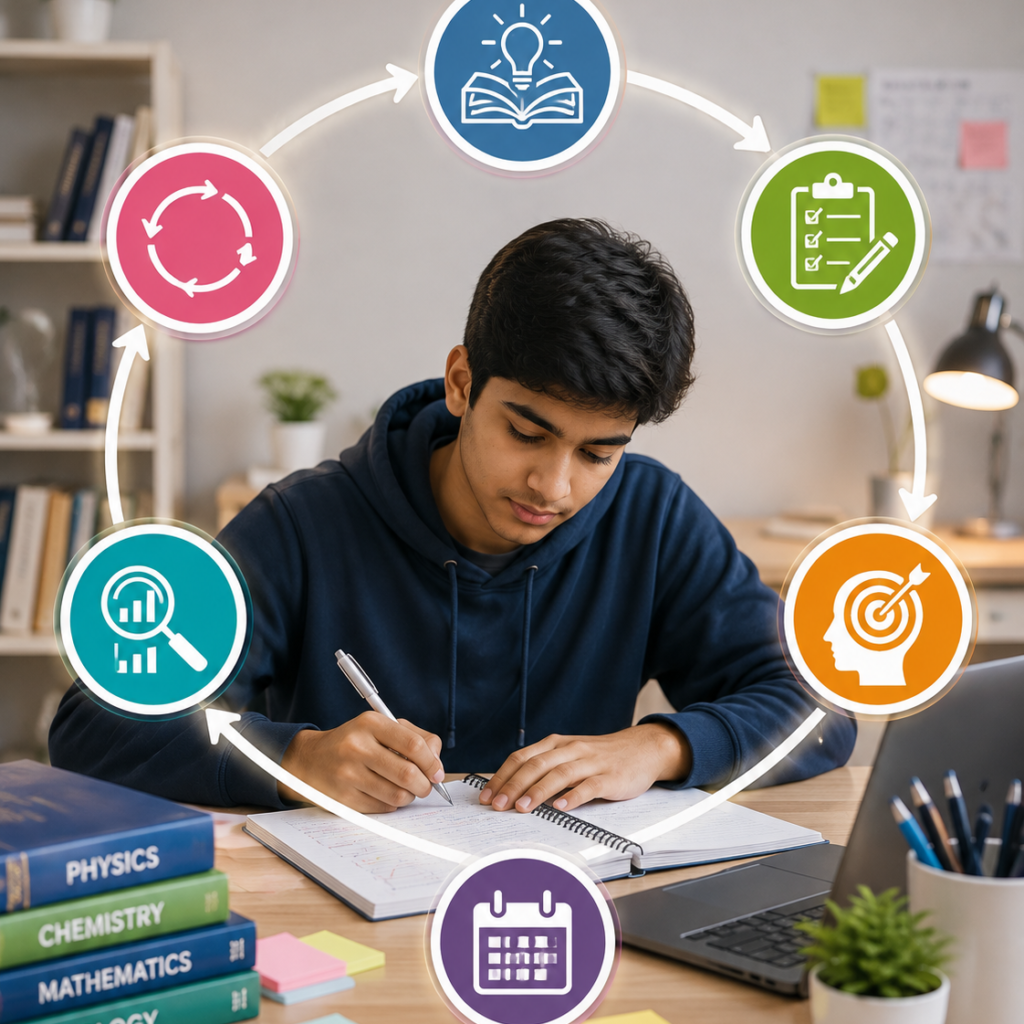
Learning doesn’t end when the class ends.
Students need opportunities to revisit concepts, retrieve information, and practice independently.
After learning a topic, students can reinforce it through:
- Revision
- Practice questions
- Active recall
- Previous-year questions
- Tests
- Error analysis
The goal is to gradually move knowledge from short-term familiarity to long-term understanding.
10. Every Student Is Different
Two students can attend exactly the same class and have completely different learning needs.
One may understand a topic immediately.
Another may need additional examples.
A third may understand the concept but struggle to apply it.
That’s why personalized academic guidance matters.
At Igniters Online, we aim to understand students not merely through their marks but through their learning patterns, mistakes, questions, strengths, and areas requiring improvement.
The objective is to help every student progress from their own starting point.
11. The Class Doesn’t End With “See You Tomorrow”
An effective learning cycle continues beyond the live session.
Students should leave a class knowing:
- What they learned.
- What they need to practice.
- Which concepts require revision.
- What questions they should attempt.
- Where they need additional support.
This creates continuity between classroom learning and self-study.
What Makes an Igniters Online Class Different?
The difference is not simply that the class happens online.
The difference is how the online environment is used.
We aim to combine:
Conceptual Teaching
Understanding the “why” behind concepts.
Interactive Learning
Students actively participate rather than simply watch.
Problem Solving
Students learn to approach unfamiliar questions independently.
Personalized Guidance
Students receive support according to their individual learning needs.
Regular Practice
Concepts are reinforced through meaningful questions and assessments.
Mentorship
Students receive guidance beyond individual lectures.
A Typical Igniters Online Learning Cycle
The complete learning experience can be represented simply:
Curiosity → Concept → Interaction → Problem Solving → Feedback → Revision → Application
This cycle is more powerful than simply:
Lecture → Notes → Test
because the student remains an active participant throughout the learning process.
Who Can Benefit From This Approach?
Igniters Online supports students across different stages of their academic journey, including students from Classes 8 to 12 preparing for:
- School and Board Examinations
- IIT-JEE
- NEET
- Science Olympiads
- IAT
- NDA
- Other science and mathematics-focused examinations
The underlying philosophy remains the same:
Build strong fundamentals first. Then build advanced skills on top of them.
The Bigger Goal: Learning Beyond the Examination
An examination is an important milestone, but it shouldn’t be the final purpose of education.
A student who learns only how to answer familiar questions may perform well in a particular test.
A student who learns how to think, question, analyse, and solve problems gains a skill that remains valuable far beyond the examination hall.
That is the kind of learning experience we aim to create at Igniters Online.
Final Thoughts
A typical class at Igniters Online is not simply a teacher speaking to students through a screen.
It is designed as a learning process in which students understand concepts, ask questions, solve problems, receive feedback, and gradually become more independent learners.
Online education gives us the technology to connect teachers and students. But technology alone cannot create meaningful education.
Good teaching, active learning, personalized guidance, and genuine mentorship are what make the difference.
At Igniters Online, our aim is to use technology as a tool—not as a replacement for good teaching—to help students develop strong foundations in Science and Mathematics and confidently pursue their academic goals.
Because online education should not simply bring the classroom to your screen. It should make learning better.
Leave a Reply